
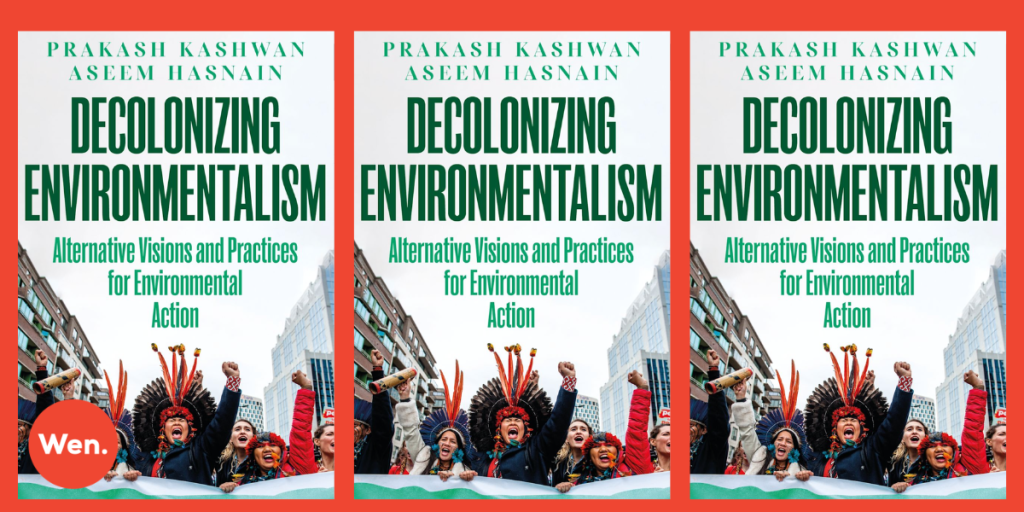
Last month, Wen’s Climate Sisters and the Centre for Joined-Up Sustainability Transformations (JUST Centre) hosted a talk and Q&A with Professor Prakash Kashwan, political scientist and author of Decolonising Environmentalism, at Manchester Museum.
The event brought together campaigners, researchers, students, community organisers and members of the public to explore what it means to truly decolonise environmentalism, and how we can build climate action rooted in justice, equity and lived experience.
Here, Anisa, Climate Sisters Programme Manager in Manchester, reflects on the event, the conversations it sparked and why these ideas matter for building a more just and inclusive climate movement.
Why this conversation mattered to me
As Climate Sisters Programme Manager in Manchester, I spend much of my time working alongside women whose lived experiences are often missing from conversations about climate change.
Through Climate Sisters, we support women to build confidence, develop leadership skills and influence the decisions that affect their communities. Every programme reminds me that people closest to environmental injustice often have the deepest understanding of both the challenges and the solutions.
Listening to Professor Kashwan’s talk reinforced why this approach is so important.
Decolonisation is an ongoing practice
One of the most thought-provoking ideas from the evening was that decolonisation is not simply about addressing the past. It is an ongoing practice of questioning dominant narratives, recognising whose knowledge has been centred or marginalised, and reimagining more equitable ways of living, learning and leading.
A key takeaway for me was that decolonisation is not simply about increasing representation or diversity. It is about examining the power structures, systems and worldviews that continue to shape our institutions, environmental movements and policymaking today.
The talk encouraged us to reflect on how colonial legacies remain embedded in education, environmentalism and public policy, and what it means to actively challenge those patterns in meaningful ways.
What stayed with me
The discussion that followed showed how relevant these ideas are to people’s everyday lives.
Participants shared reflections on how decolonisation connects to their own work, communities and lived experiences. The Q&A created space for honest questions, different perspectives and collective learning, highlighting both the challenges and opportunities of putting decolonial thinking into practice.
For me, it was a reminder that meaningful change begins with curiosity, dialogue and a willingness to examine our own assumptions.
These conversations also reflect what we see through Climate Sisters. Lasting climate action isn’t created by designing solutions for communities. It comes from creating space for communities to shape those solutions themselves.
At Wen, that’s what feminist climate justice means. It means recognising lived experience as expertise, questioning who holds power and working alongside women and communities to create fairer, healthier and more sustainable futures.
Find out more
Find out more about Climate Sisters and Wen’s work for feminist climate justice.
Read our blog on how decolonial feminism shapes our programmes and partnerships.
Read the Wen briefing ‘Decolonial Feminism and Climate Justice’

Anisa Saleh, Climate Sisters Programme Manager – Manchester/NW
Anisa is a coach, facilitator and consultant working at the intersection of environmental justice, arts, culture and social impact. Rooted in anti-oppressive practice and nature-based leadership, she brings over a decade of experience supporting individuals and organisations to embed equity, care and inclusion into their work. Anisa offers a perspective shaped by community-centred practice, social justice and liberatory structures.
