

As part of Refugee Festival Scotland 2026, Wen’s Programme Manager, filmmaker and former Climate Sister, Meray Diner, was invited to introduce Black Water, a powerful documentary exploring climate change, displacement and resilience in Bangladesh.
In this reflection, Meray shares why storytelling and documentary filmmaking matter, what Black Water reveals about the unequal impacts of the climate crisis, and why listening to the voices of women and marginalised communities is essential for building climate justice.
Black Water Film Screening Introduction by Meray Diner, Wen
Refugee Festival Scotland kicked off on 12th June 2026 and I was invited to do an introduction on the film programme day to the powerful and visually striking film Black Water as a filmmaker and programme manager at Wen. The film screening was curated with the Scottish Documentary Institute.
My name is Meray, and I am a Programme Manager at Wen. I lead Climate Sisters Scotland, a programme dedicated to amplifying the voices of racialised and marginalised women within the climate justice movement.Through Climate Sisters, we bring women together to share their knowledge, experiences and ideas, learn from one another, and build a community and sisterhood rooted in collective action. Together, we explore the climate crisis through gender, racial and environmental justice perspectives and develop solutions shaped by women’s lived experiences. The programme has hubs in London, Manchester and the North West, and Scotland.
My connection to this project is deeply personal. I joined its pilot programme during COP26 in Glasgow as a Climate Sister. I came into the project as a filmmaker; my own work explores the relationships between people, land, water, and the environment through a feminist lens. What we often find is that women’s and marginalised communities’ voices are often missing from the climate change agenda and even on the screen.
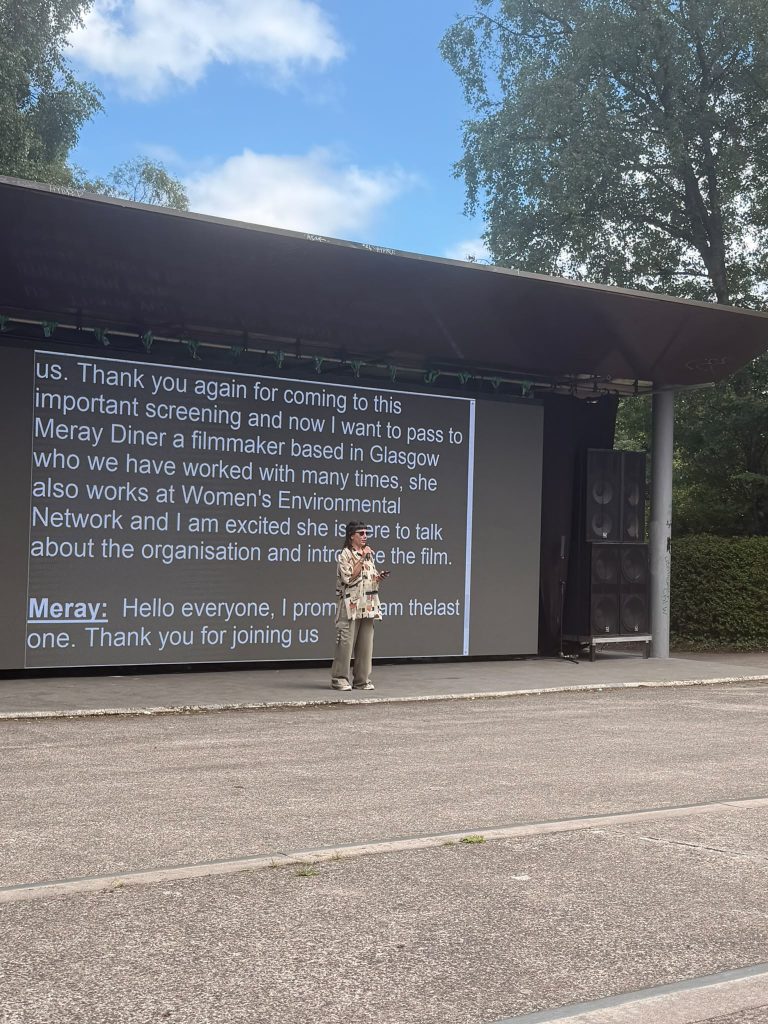
Meray introducing the film at Queen’s Park Arena, Glasgow, Scotland
Climate Change, Displacement and Bangladesh’s Climate Reality
The film I introduced at Queen’s Park Arena, Black Water is interesting because it examines the climate crisis in Bangladesh through a gendered perspective.
Bangladesh is one of the places in the world most vulnerable to climate change. During the monsoon season the country floods, rivers swell and change their channels, moving up to 20 meters each year. Lokhi and her family are preparing to leave their home before everything washes away. They are migrating to Dhaka, the fastest growing city in the world, with thousands of climate refugees arriving every day in the capital.
Women’s Voices and Leadership in the Climate Crisis
It reveals, through the main character Lokhi and her surroundings, how women often carry caregiving roles within their homes while also showing them undertaking physically demanding and dangerous work to support their families and communities. At the same time, the film highlights women as leaders, advocates, and thinkers who are actively shaping conversations around climate justice and demanding change through another character who is a radio presenter and an activist.
As we find in the film, more than 800,000 people have already been internally displaced from their homes. By 2050, Bangladesh could lose between 17 and 20 percent of its southern coastline due to rising sea levels, forcing an estimated 30 million people to relocate in what could become one of the largest climate-driven migrations in human history.
Here in the UK and Europe, we must also prepare for climate migration. However, the UK and Europe are not ready to accept the consequences of the extractivism and colonialism they have long practised in countries such as Bangladesh. These catastrophic events come at the expense of the livelihoods and safety of Black, Brown, Indigenous, and other marginalised communities.
What Black Water Teaches Us About Climate Migration
Through the power of documentary filmmaking which includes a participatory approach and footage filmed by a young girl within the featured family in the film, Black Water demonstrates what many of us imagined as a distant future is already a daily reality for millions of people.
Throughout the film, a voice of a spiritual character talks about the water as a backdrop, he becomes a voice. He carries a warning about what is still to come and reminds us of our deep dependence on healthy ecosystems. As waters rise through industrial activity and pollution, it reveals both the fragility and the urgent need for collective action.
Black Water is a great example of the power of documentaries which help us witness and understand what’s really happening, through facts and realities and connect us over stories across the globe with our common struggles and resistance.
The Power of Documentary Storytelling for Climate Justice
This documentary is not only educational and informative, but also deeply moving and inspiring. I hope it encourages audiences to reflect on the realities of climate change, human struggle and climate migration, which are often portrayed very differently in mainstream media.
After watching the film, I hope you stay curious and informed, seek out different perspectives, and use storytelling as a way to build understanding, solidarity and allyship. Talk to people who may have different views from your own, these conversations are an important part of creating change.
Building a fairer and more sustainable future starts with community. Talk to your neighbours, discuss these issues with family, friends and colleagues, and get involved in local environmental projects, groups or campaigns.
Stay Connected with Wen’s Work on Climate Justice
To stay connected with Wen’s work, subscribe to our monthly newsletter, follow us on Instagram and LinkedIn and explore our resources to learn more about climate justice and collective action. Together, we can challenge the systems driving inequality and environmental harm and help create a more sustainable and equitable future for all.
You can watch Black Water at Doc Screen of the Scottish Documentary Institute at Edinburgh Film House on Saturday the 20th June, 3pm. This event is in collaboration with Take One Action and part of Refugee Festival Scotland. It will feature an extended introduction and post-screening reflection on pathways to action or find it on other streaming platforms later on and I hope you enjoy the film.
Find out more about Climate Sisters

Meray Diner, Climate Sisters Programme Manager – Scotland
Meray joined Wen as a former Climate Sister and brings over a decade of experience in the arts and cultural sector, with a strong focus on amplifying underrepresented voices in climate change and social justice. As a filmmaker, her work explores the relationship between human activity, land, environment, and water, studying themes such as conflict, identity, and borders through a feminist lens.

